Review PlayGrand Casino rules for UK players in 2026. Learn about slot stake limits, credit card bans, GAMSTOP compliance, and account safety. Read now!
PlayGrand UK rules should be read through a Great Britain lens, not as a blanket promise for every part of the United Kingdom. The key checks are the Gambling Commission licence framework for Great Britain, online slot stake limits, the credit-card gambling ban, customer identity verification, financial vulnerability checks, bonus and reward rules, GAMSTOP and operator self-exclusion, and safer payment blocking. For PlayGrand specifically, official support also states UK online slot limits of £5 for players aged 25 and over and £2 for players aged 18 to 24 from 21 May 2025. Players seeking to limit their gambling activities should familiarize themselves with GAMSTOP self-exclusion and account limits.
The practical point is not that every account, bonus, payment or withdrawal is guaranteed. It is that each PlayGrand decision should be tested against the rule that affects it. A bonus question may really be a terms question. A payment question may really be a credit-card or verification question. A login question may really be a safer-gambling or account-status question.
PlayGrand UK Regulations and Player Rules
The first rule is about geography. The Gambling Commission regulates remote gambling offered to consumers in Great Britain. Great Britain means England, Scotland and Wales. Northern Ireland has a separate gambling-law framework, although Gambling Commission material also explains that advertising remote gambling to Northern Ireland consumers can still create licensing issues. Because of that split, this site avoids saying that PlayGrand is simply legal across the whole UK without caveats.
That distinction matters for PlayGrand because the brand evidence used in this project is Great Britain-facing. White Hat Gaming Limited is the operator context used for the PlayGrand licence and domain checks elsewhere on the site, and the exact licence and domain trail is handled on the PlayGrand licence evidence page. This rules page does not repeat that whole register check. It explains how the rules that sit around a Great Britain remote casino account can change the experience of using the site.
A thin review often compresses this into one line such as “UK licensed”. That is too blunt. A better reader question is: which rule changes the next action I am about to take?
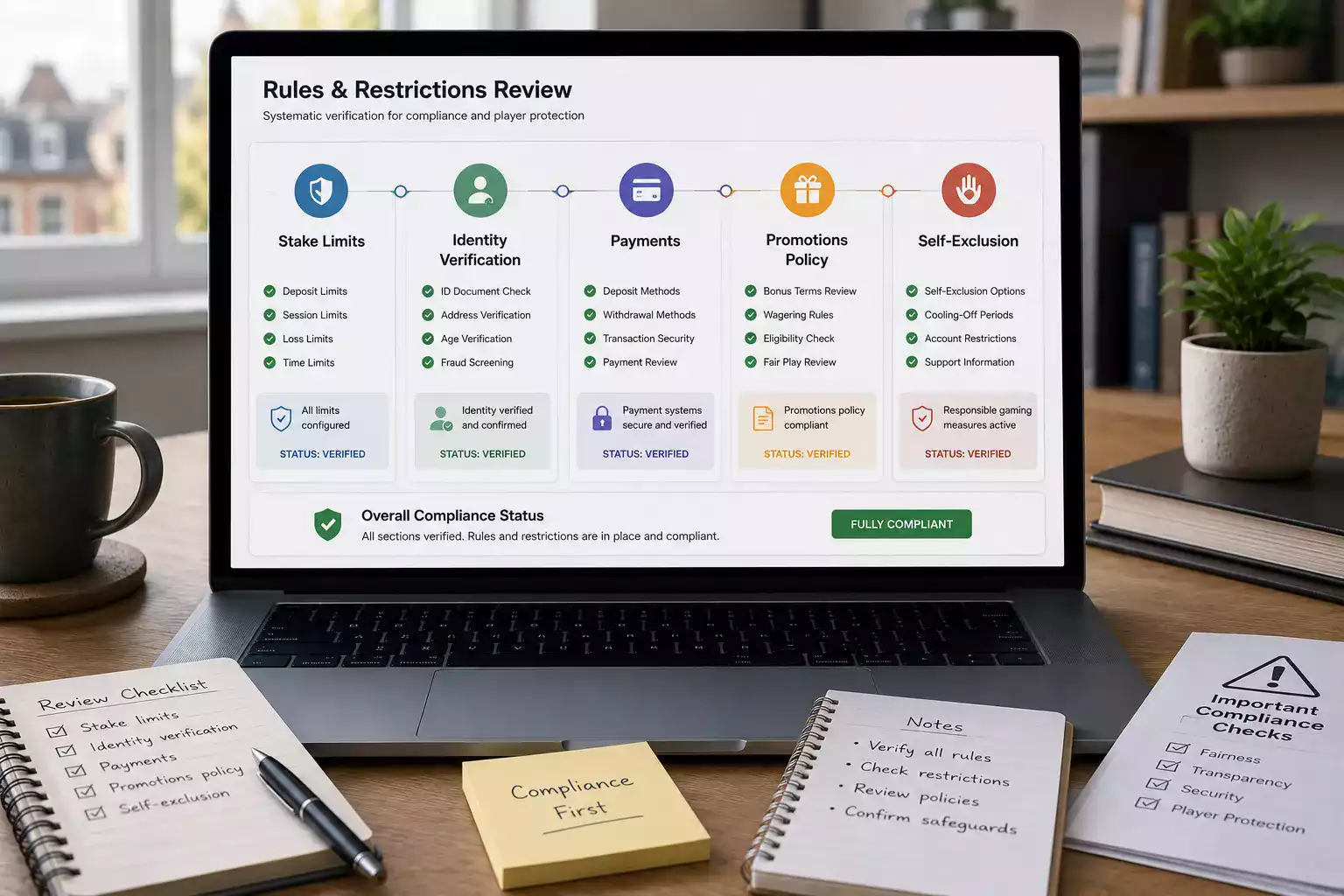
The PlayGrand rule map
The table below keeps each rule tied to a practical decision. It is deliberately not a shortcut to bypass a check or avoid a restriction.
Rule area
What the rule affects
How to use it before a PlayGrand decision
Great Britain remote licensing
Whether a remote casino service needs a Gambling Commission licence for Great Britain consumers.
Check the licence and domain evidence before relying on marketing or affiliate summaries.
Online slot stake limits
Stake-per-spin limits for online slots, not every casino product.
Do not expect a slot stake above the relevant age band to be available or safe to chase.
Credit-card ban
Gambling businesses must not accept credit-card payments for gambling.
Do not treat any credit-card deposit claim as a normal UK casino feature.
Customer identity verification
Name, address, date of birth and related identity checks before gambling is permitted.
Prepare accurate details and document evidence before a deposit or withdrawal becomes urgent.
Financial vulnerability checks
Light-touch checks for customers above defined net-deposit thresholds.
Expect some account or payment friction to be safer-gambling related, not just cashier friction.
Bonus and reward rules
Promotion design, wagering limits and product-mixing restrictions under LCCP changes.
Read current official terms before treating any offer headline as usable.
GAMSTOP and self-exclusion
Multi-operator online self-exclusion and operator-level exclusion arrangements.
Respect exclusions and account limits. Do not look for workarounds.
Slot stake limits are specific, not a general casino limit
One of the most concrete PlayGrand rules is the online slot limit. PlayGrand support states that UK online slot limits are £5 per spin for players aged 25 and over and £2 per spin for players aged 18 to 24 from 21 May 2025. The Gambling Commission’s online slots guidance also records the same age-banded limits and makes clear that the condition applies to remote casino operating licences. Read our step-by-step tutorials and expert tips on the best UK casino review site to enhance your gaming experience safely.
This should not be stretched into a claim about every game on PlayGrand. It is about online slots. If you are comparing games, the separate slots and stake limits page explains why slot stakes, game speed and product category matter. A reader who only sees a game catalogue can miss the rule that sits under the stake selector.
The information gain here is the age band. The issue is not only “what is the maximum stake?” It is also “which age band does the rule apply to?” That difference can explain why two adult players may see different limits.
Payments are shaped by the credit-card ban and verification
Gambling businesses must not accept credit-card payments for gambling, including online casino and bingo. For a PlayGrand reader, that means a page claiming easy UK credit-card casino deposits should be treated as unreliable. The rule does not prove which debit cards, bank options or e-wallets will appear in a specific account. It only rules out credit-card gambling as a normal permitted UK route.
Payment questions also connect to identity checks. Gambling Commission licence condition 17.1.1 requires remote licensees to obtain and verify customer identity information before customers are permitted to gamble and to tell customers before deposit what identity documents or other information may be needed. That is why the PlayGrand verification page belongs next to cashier decisions.
If a deposit or withdrawal is delayed, do not assume it is simply a bank problem. It may involve account details, payment ownership, address evidence, safer-gambling checks or the method used. The broader payment methods guide explains those payment-path checks without promising a specific method, fee, limit or payout speed.
Financial checks are not bonus obstacles to bypass
The Gambling Commission has introduced light-touch financial vulnerability checks for customers with net deposits above the relevant monthly level. The public rule is about identifying acutely financially vulnerable online customers and supporting safer play. It should not be described as a trick, a penalty or a challenge to work around.
For PlayGrand, the safest reading is practical: if account activity triggers a question, the correct response is to read the account message, use official support if needed, and stop if the issue points to harm, unaffordable play or self-exclusion. Do not create another account, change payment routes, borrow someone else’s payment method or look for a mirror site.
The same caution applies to marketing. Gambling advertising in Great Britain must be socially responsible, and Gambling Commission LCCP changes include reward and bonus controls such as limiting wagering requirements and banning mixed products within incentives. The PlayGrand bonus checks page therefore avoids claiming current bonus amounts, codes, free spins, maximum bets or wagering terms unless visible official terms support them.
GAMSTOP, account limits and payment blocks
GAMSTOP allows online self-exclusion from participating online operators with one request, and Gambling Commission guidance says gambling businesses must also have their own self-exclusion arrangements. Payment blocking through banks is recognised by safer-gambling guidance as a practical support tool. These are not inconveniences to solve around. They are stopping points.
If you are reading this page because a PlayGrand login, payment or account message points to self-exclusion, use the GAMSTOP and self-exclusion guide. It is written to answer high-risk searches without giving bypass advice.
The useful distinction is this: GAMSTOP, operator self-exclusion, bank gambling blocks and account closures may look similar when the result is “you cannot continue”, but they come from different systems. A support conversation can clarify an account message, but it should not be used to defeat a safety decision.
Practical checklist before using PlayGrand
Check the Great Britain licence and domain evidence before relying on a review summary.
Use Great Britain wording when discussing UK casino regulation, and keep Northern Ireland caveats in mind.
Do not rely on a credit-card deposit claim for UK online casino play.
Read slot stake limits as slot-specific and age-banded.
Prepare identity, address and payment ownership evidence before relying on withdrawals.
Read bonus terms from an official visible source before treating any headline as usable.
Stop if account access, support, bank blocking or self-exclusion points to gambling harm.
The main PlayGrand UK review brings these threads together. This page is narrower. It gives you a rule-to-player-experience map, so you can see when a PlayGrand question is really a licensing, staking, payment, verification, bonus or safer-gambling question.
Bottom line on PlayGrand UK rules
The safe summary is cautious but useful. PlayGrand should not be judged only by a bonus headline or a one-word licensing label. In Great Britain, remote casino play sits inside a framework covering licensing, identity verification, slot limits, credit-card restrictions, financial vulnerability checks, promotion design and self-exclusion. Those rules can shape what you see in the lobby, cashier, account area and support messages.
This page does not provide legal advice and does not claim that every UK reader can register, deposit, claim a bonus or withdraw. It explains the checks that a UK reader should make before taking those steps. For the adjacent planned topic of tax and prize treatment, use the tax and winnings guide when that question is the real reason you are comparing sites.
FAQ
Why does this site separate Great Britain from the wider UK?
The Gambling Commission regulates remote gambling offered to consumers in Great Britain, while Northern Ireland has separate gambling arrangements. That is why careful pages avoid turning GB evidence into a blanket whole-UK statement.
Which rules matter most for a player decision?
The most practical checks are age and identity verification, credit-card restrictions, safer-gambling tools, self-exclusion, slot design rules, payment ownership and promotion terms.
Can safer-gambling restrictions be worked around?
No. Restrictions, limits and self-exclusion should be treated as protections. This site does not give bypass advice and encourages readers to pause when gambling stops feeling controlled.